
Stock Opname
Transaction → Stock Opname is the physical count: someone walks the site scanning assets, and Fisetra compares what was found against what the register claims.
It is the only transaction that does not change assets directly. A count reports what is out of step; correcting it is done afterwards with the ordinary documents. That separation is deliberate — a count is evidence, and acting on evidence is a separate decision.
INFO
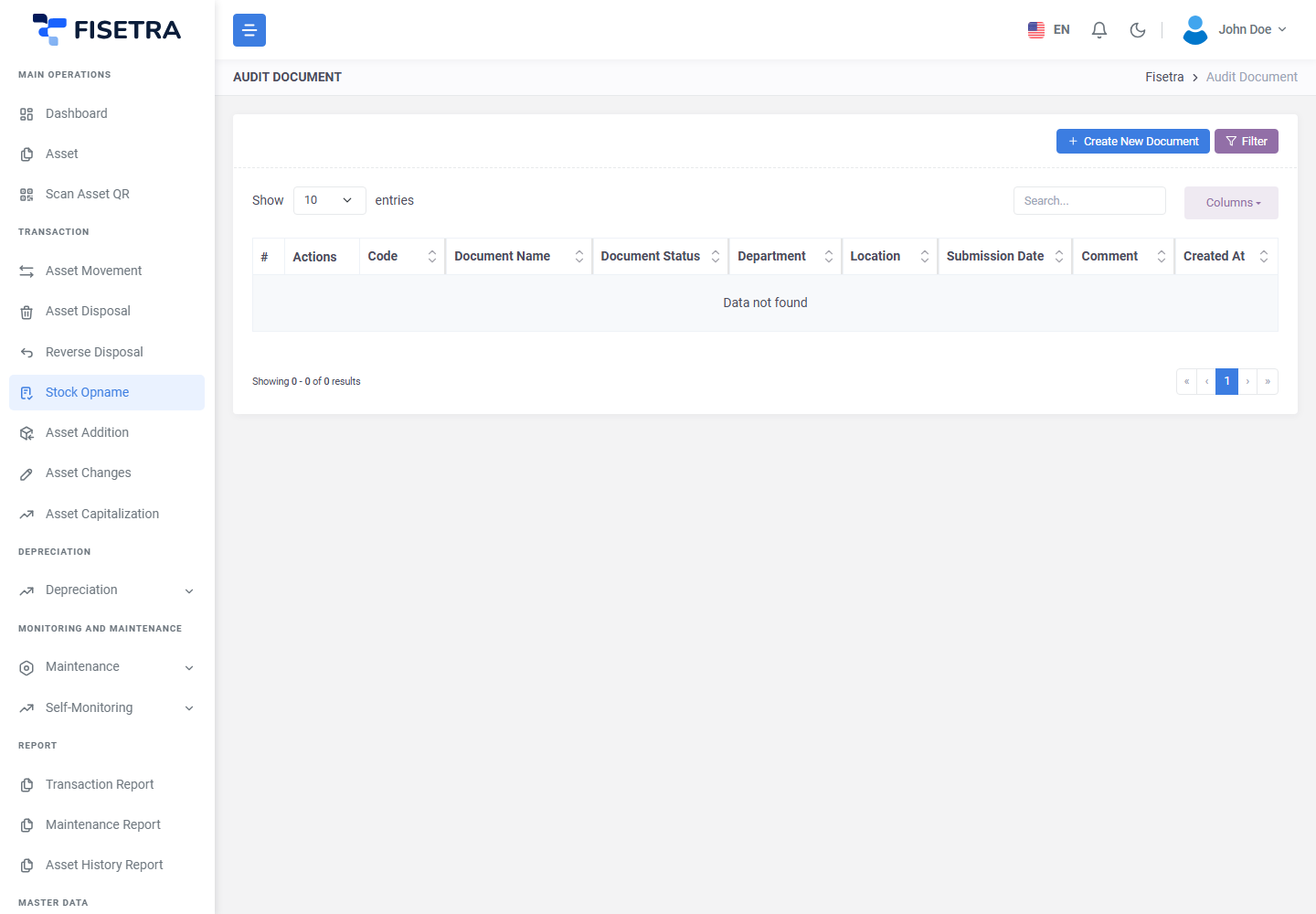
The menu entry reads Stock Opname, but the page itself is headed Audit Document and its documents are called audit documents. They are the same thing.
The lifecycle, submitting, fixing and voiding are in Document basics.
WARNING
While a Stock Opname is active, the assets in its scope are locked for other transactions. You cannot move, dispose or change an asset that is being counted. This keeps the count meaningful — the register cannot shift underneath it. Complete or void the count to release them.
The whole flow
- Create the document and set its scope
- Allow devices to download the asset list
- Count in the field by scanning
- Review the findings, grouped by what was discovered
- Reconcile the differences
- Submit for approval
- Raise follow-up documents for what the count found
Create the document and set the scope
- Open Transaction → Stock Opname and select the create button.
- Fill in the header: the title and the Submission Date.
- Set the scope — specific departments and locations, or all of them.
- Save. The number is generated and the status is
DRAFT.
The scope decides which assets are expected to be found, and which are locked. Counting one warehouse should scope to that location; scoping to everything locks the whole register.
Allow devices to count
Field counting is done with a device that downloads the asset list, scans, and uploads the result.
On the document, enable device download and register the devices that may take part. Each device checks in, pulls the list for the scope, and the counting session begins.
Fisetra also has a scanning screen on the document itself for counting without a separate device.
Count in the field
Each asset is scanned by its barcode. Fisetra classifies every scan as it arrives, and each asset can carry a Comment — useful for noting damage or anything odd.
When counting is finished the device checks out, and the results are uploaded.
Review the findings
This is where the value is. The document groups everything into tabs:
| Tab | What it means | Typical follow-up |
|---|---|---|
| Assets scanned | Found exactly where the register said | None |
| Assets from other locations | Found, but somewhere else | Asset movement |
| Assets from other departments | Found, but under a different department | Asset movement |
| Assets not scanned | Expected but never found | Investigate, then asset disposal |
| Disposal assets found | Marked disposed, but physically present | Reverse disposal |
| Reconciliation Assets | Resolved during reconciliation | Already handled |
Assets found that are not in the register at all can be added from the count with Add Asset, which captures the details on the spot.
Read Assets not scanned carefully before concluding anything is lost. An asset can be missing from a count because it was genuinely gone, because it was somewhere outside the scope, or because its label would not scan.
Reconcile
Reconciliation is how you resolve a difference and record the decision.
- Select the assets to resolve.
- Select Reconcile.
- In Reconciliation Confirmation, set the New Status, add a Comment, and for anything being written off, set the Disposal Date.
- Confirm.
Reconciled assets move to Reconciliation Assets with your decision attached, so the approver sees not just the discrepancy but what you concluded about it.
INFO
The disposal date cannot be earlier than the start of the current month. If it is rejected, that is the rule — Fisetra will not let a count backdate a write-off into a closed period.
Attachments and Carbon Copy
Attach the signed count sheet or minutes on the Attachment tab, and add anyone who should receive the outcome — finance, internal audit — on Carbon Copy.
Submit and approve
Select Document Confirmation. The document becomes PENDING and approvers are notified.
On approval the count is recorded as the official result. The asset register is not rewritten — approving a count endorses the findings, it does not move or dispose anything.
If the document is rejected it returns to you as a DRAFT; fix it and use Confirm Fix.
Act on the findings
The count tells you what is wrong. Fixing it is separate work:
| Finding | Document to raise |
|---|---|
| Asset in the wrong place | Asset movement |
| Asset genuinely missing | Asset disposal |
| Disposed asset found | Reverse disposal |
| Asset details wrong | Asset changes |
| Asset never registered | Asset addition, if not added during the count |
Each of these goes through its own approval, so the correction is authorised on its own merits rather than riding along with the count.
Common problems
| Problem | Why | What to do |
|---|---|---|
| Cannot move or dispose an asset | It is inside an active Stock Opname | Complete or void the count first |
| A device cannot download the list | Device download is not enabled, or the device is not registered | Enable it on the document and register the device |
| An asset is missing from the count list | It is outside the scope | Check the header scope |
| A scan is rejected | The barcode does not match any asset in scope | Check the label; the asset may be unregistered — use Add Asset |
| A disposal date is refused | It is before the start of the current month | Use a date within the current month |
| Approved, but the register did not change | Approving a count endorses findings only | Raise the follow-up documents above |